Semi Formal
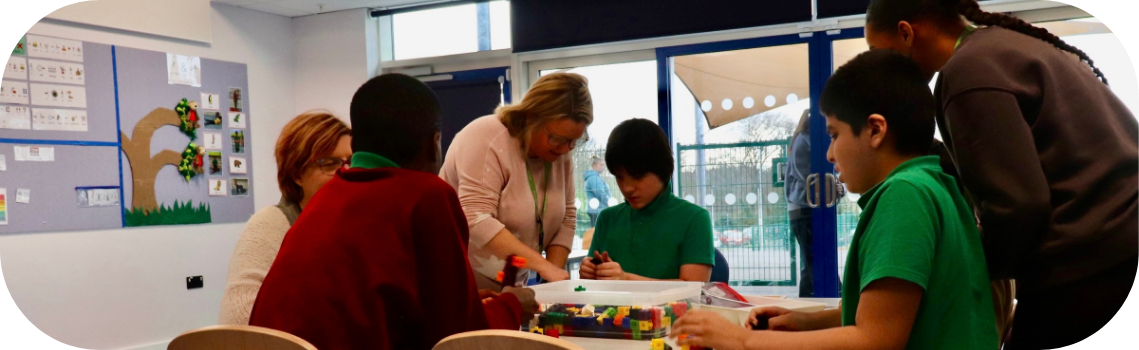
This pathway is designed for children and young people who are working within the pre-key stage standards or key stage one of the national curriculum and are ready to apply their skills in a more functional way. Children and young people follow a subject specific curriculum enriched with a range of experiences including community engagement and contextualised learning. Learning in this pathway is a mix of sensory based learning and a more formal structure to meet the needs of the individual child.
Who is the Pathway for?
This pathway is typically for pupils with Severe Learning Difficulties (SLD) or those with complex needs who are working beyond the Engagement Model but for whom the standard National Curriculum requires significant adaptation.
These learners often have a spiky profile, excelling in some areas while needing intense support in others, and require a curriculum that is paced to allow for deep consolidation and repetition.
An Integrated Approach
Learning on the Semi-Formal Pathway is active, repetitive, and highly scaffolded. We move from the concrete to the semi-abstract, always grounding new concepts in real life, relatable experiences.
Within this pathway we promote:
Curriculum Focus Areas
The Semi-Formal curriculum encompasses a range of exploratory and investigative approaches alongside more formal learning experiences.
-
English: Children and young people read a wide range of texts to support their oracy, vocabulary, comprehension, and writing development. Writing is purposeful and covers a range of genres which leads to a planned event.
-
Maths: We use the mastery approach to teaching maths, ensuring all pupils have access to appropriate representations, structures, and variations to support making mathematical connections in their learning.
-
Science: This is continued through our Post-16 curriculum offer and gives children and young people an opportunity to develop their understanding of the world around them whilst setting up simple tests and performing experiments.
-
History & Geography: Children and young people begin to understand simple chronology and events in the past and present. They compare geographical features within their experiences.
-
Art and Design: Children and young people learn about and explore materials and their properties through a range of media including sculpture, painting, drawing, collage, printing, and textiles. Art is continued through our Post-16 curriculum as a leisure activity and in Year 14 as a unit for OCR accreditation.
-
Music: Children and young people develop their understanding of beat, pulse, tempo, dynamics, and pitch. They experience a wide range of music from different genres and cultures around the world.
-
Computing: Children and young people develop their understanding of e-safety and digital literacy. They develop their skills in communication through multimedia and data as well as programming and algorithms.
-
PSHD and RSE: Children and young people develop their awareness of personal, social, and health skills, developing their understanding further in Key Stages 4 and 5 where relationships and sex education become the focus.
-
Religious Education: Immersion in a range of experiences and artefacts supports children and young people’s understanding of similarities and differences in the world and the importance of caring for others.
-
Food Technology: By exploring a range of foods and learning simple skills, children and young people learn skills for life and develop an understanding of their likes and dislikes.
-
PE: Children and young people enjoy a wide range of PE experiences, and through experiencing a range of sports, they develop their gross motor skills. PE experiences may be on our extensive site in the sports hall, MUGA, adventure playground, hall, or playground, or may be offsite—for example, visiting The Dell Stadium, swimming, the park, or the country parks in the local area.
-
Forest School, Horticulture, and Outdoor Learning: Our sensory pathway offers pupils a wide range of outdoor learning opportunities, including regular forest school sessions, horticulture sessions in our on-site allotment, and opportunities for orienteering around the school site.
Assessment
On the Semi-Formal Pathway, we track progress using a range of developmental frameworks that recognise small, incremental steps of success. Skills are contextualised using a range of different experiences and environments.